Our Homelessness Services are Working


I was recently asked by United Way Middlesex Elgin to speak to a group of their supporters here in London about local homelessness and the impact of the work they fund. Below is a condensed version of what I shared, because I think the message is important beyond that room. Homelessness is rising here and in cities across Canada and globally, and as it rises more people are asking whether our homelessness services are failing. My take? They aren't.
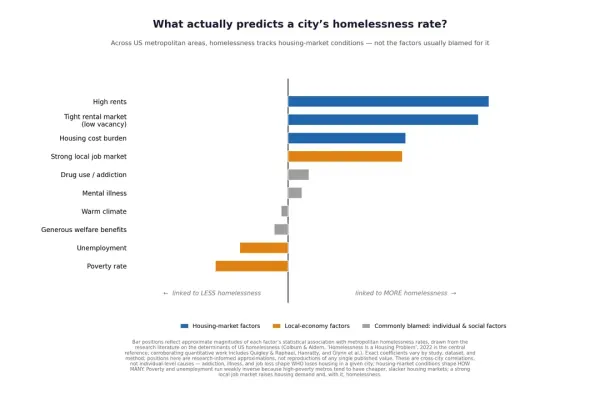
Homelessness is a housing problem
Where homelessness is rising in almost every country, it is clear that in countries like Canada a huge part of that challenges is that housing is getting more expensive.
You will hear other explanations for homelessness, usually focused on drugs or mental illness. I started working as a nurse in the Old East Village in London in 2004. At that time we had OxyContin. After that we had a crystal meth crisis. Now it's fentanyl. The drugs change, but the issue of substance use has been with us the whole time. The same is true of major mental illness, the rates of the conditions we tend to see among people who are chronically homeless have not changed. Yet the rate of homelessness has increased drastically. This is a housing crisis, and homelessness is one visible manifestation of that crisis. I've written about this here, and we have a book coming out soon, Structural Solutions to Ending Homelessness: Global Evidence to Support Policy Transformation, that lays it out in much more detail.
This is important to all of us because other narratives risk distracting us from the things we have evidence for. Once we start talking about reopening psychiatric hospitals, forcing people into treatment, or incarcerating people, we lose sight of what works. Those responses only feed the spiral of people entering homelessness.
The services are working
The other narrative I'm hearing is that because homelessness keeps going up while our services exist, maybe those services aren't working. This is a twisted logic, like saying because people still die from cancer we should probably just stop giving chemotherapy.
Prevention is one key example of what works but it's not talked about much because it's hard to have anything to see when we're just talking about stopping something from happening. But through rapid financial assistance alongside human support for people in crisis, London agencies are preventing evictions.
We are also rehousing people. London has a by-name list of people experiencing homelessness, so we know who is out there and what their level of need is. We also know that 476 people left that list in 2024. That is a big number, and it represents a ton of work by our local agencies. The problem is that the number of people entering crisis remains greater than the number exiting. That is not the same as people not exiting homelessness.
The Thompson Road example
Coming out of the pandemic, the City received federal Rapid Housing dollars and built a building on Thompson Road. They populated it with people from the by-name list. This means the City created a space with a very high acuity of need, and Indwell took on the challenge as the operator of this site.
Of the original tenants, 83% have remained housed in that building. If those same folks had been put into the private market, I suspect that number would be closer to zero.
We can house people with high needs directly from the street, as long as the right supports are in place, and organizations in London are doing exactly that in relatively large numbers. We are now doing local evaluation to track these outcomes and figure out how this can work even better.
Our challenge is scale
Our organizations know what works. They know how to rehouse people and what supports are needed to keep them housed. The issue is the broader affordability crisis, with housing a big part of it, which is pushing more people into crisis than we are able to help out of it.
So we don't need to reinvent the wheel, and we don't need to start putting people in jails or hospitals. We need governments building more affordable housing. And we need more organizations providing the health and social supports that make that housing work for people with the most complex needs. That is what the agencies funded by United Way do, and it's why I have supported United Way as a board member, as an employee of a United Way funded organization, and as a volunteer.
These agencies work, and we have the evidence that they work. What they need is the capacity to do more of it.