Mental Illness Does Not Cause Homelessness

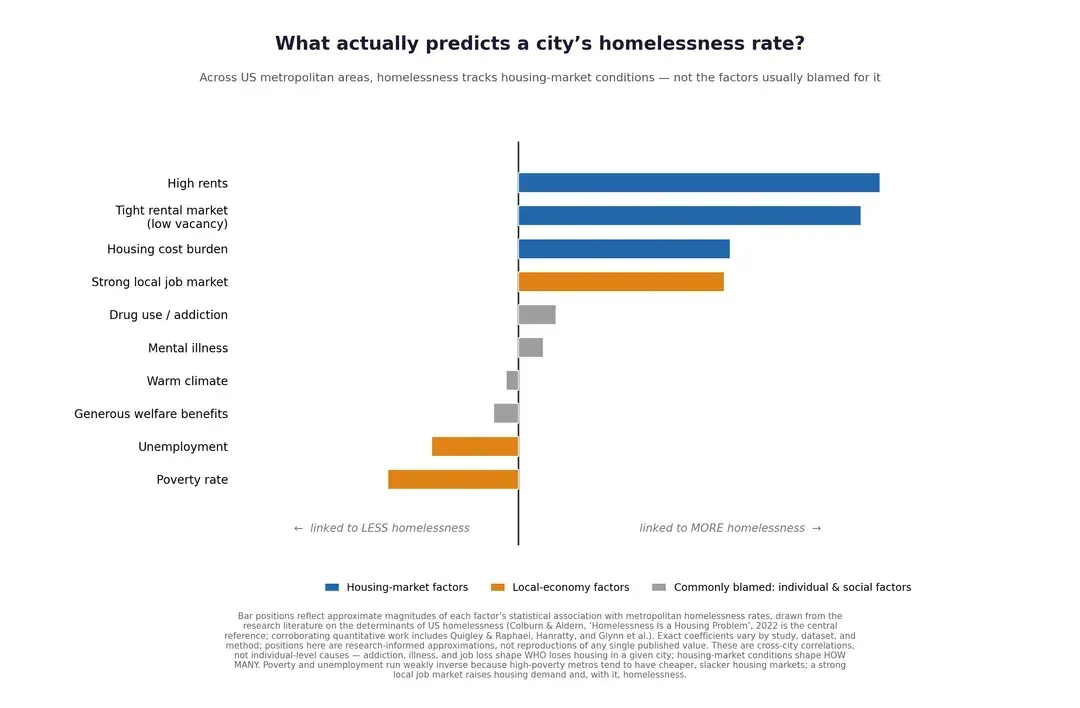
I have been meaning to write about Gregg Colburn and Clayton Aldern's book Homelessness is a Housing Problem: How Structural Factors Explain U.S. Patterns (UC Press, 2022) for a while now. A request from a friend to explain the above graph has pushed me to do so.
This chart, drawn from Colburn and Aldern's analysis of homelessness rates across US metropolitan areas, tells a story that adds clarity to the current mire of political narratives related to homelessness. Housing market conditions, particularly high rents and low vacancy rates, are the dominant predictors of a city's homelessness rate. Mental illness, drug use, poverty, warm weather, and welfare generosity provide insufficient explanations about variability in homelessness rates. Housing costs do.
Specific to mental illness and addictions, it's notable that the majority of people who live with a mental illness or an addiction do not experience homelessness. And, the rates of homelessness for people with a mental illness are massively different when comparing, for example, Toronto to Belleville. This is the crux of what Colburn and Aldern demonstrate empirically. Mental illness and addictions are not causes of homelessness at the population level. They are selection mechanisms in that they determine who falls through the cracks when housing is rare and expensive. This is a profoundly important distinction, and getting it wrong has enormous policy consequences. Hearing Canadians call for the rebuilding of mass psychiatric institutions proves we just don't get it...yet.
Why This Matters for How We Respond
If you believe homelessness is fundamentally caused by mental illness and addiction, it follows that the solution is treatment: get people sober, get people medicated, and then house them. This logic underlies treatment-first approaches and, in more coercive forms, (growing) calls for forced psychiatric hospitalization and mandatory treatment programs.
But if homelessness is a housing problem, as evidenced here, then this entire framework is backwards. Housing First, an approach that provides permanent housing without treatment preconditions, is not wishful thinking. It is the intervention that actually matches the problem. The research consistently shows that Housing First outperforms treatment-first approaches on housing stability and does not result in worse substance use or mental health outcomes. You cannot treat your way out of what is absolutely a housing crisis.
For some people, affordable housing alone is sufficient. For others, affordable housing with supports, what we call supportive housing, is what makes stable housing possible. Both are housing solutions...neither includes a treatment mandate.
This Is Not Just an American Story
Colburn and Aldern's analysis is rooted in US data, but having read extensively on homelessness globally, I can say with confidence that the same structural dynamic is playing out everywhere. There has been no major increase in rates of mental illness or addiction in high-income countries over the past two to three decades that parallels in any way the rise of homelessness. But there has been a massive increase in housing costs and homelessness has followed housing costs upwards (and not mental health trends).
The jurisdictions reversing this trend, such as Finland and Scotland, are doing so through housing availability and Housing First, not through treatment mandates. Finland has been steadily reducing homelessness for decades through a sustained commitment to building social and supportive housing. Scotland is pursuing a similar trajectory via Housing First and creating access to existing housing stock.
The Higher-Order Solution
Because homelessness is a housing problem, the most direct path to ending homelessness runs through social housing at sufficient scale to counteract the volatility of the private market. When housing markets produce rents that outpace incomes (as they do, structurally, in most high-income countries), the state has two options: subsidize demand (housing benefits) or build supply (social housing). Both have a role, but benefits without supply simply inflate rents. Supply is the durable solution and the private market can't be trusted to consistently produce that supply and offer it at an affordable rent.
This does not require abandoning supports for people with mental illness, addiction, or other complex needs. Indeed, I would suggest that in Canada we need MASSIVE investment in community-based mental health care. But it requires sequencing them correctly: House First, support as needed. I would suggest that anti-Housing First narratives, being driven by Donald Trump and friends, reflect fear from the private sector that we might return to social building.
Colburn and Aldern have done an important service in making this case rigorously and accessibly, we just need to listen to it through the noise. If you work in this sector, advocate in it, or set policy for it, Homelessness is a Housing Problem is essential reading. More importantly, its core message needs to move from the sector into the broader public conversation because as long as the public believes homelessness is primarily a mental health and addiction crisis, we will keep demanding responses that cannot possibly work.